The part worth sending to a friend
The field guide
A specific, affectionate read on how this type can show up in ordinary life. Keep what feels useful; leave the rest to the raccoons.
The quick read
- Makes a room feel quickly inhabited
- Turns ideas into forward motion
- The Social instinct leads; Chaos decides what happens next
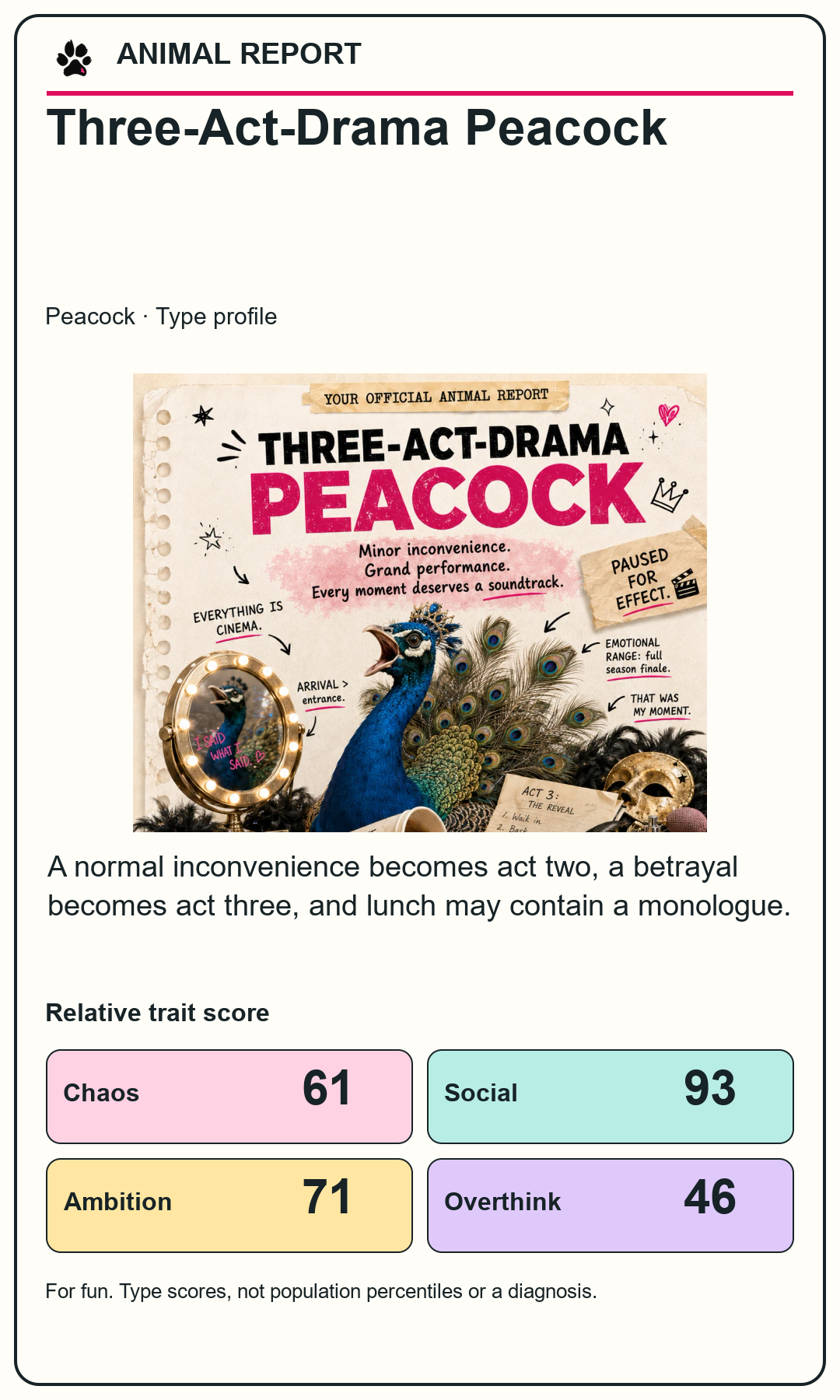
Peacock family note: Peacock energy understands that life is partly what happened and partly how well the moment was framed. You do not merely enter a room; you give it an opening shot. Attention follows because you know how to make a scene worth watching.
The real read
You understand that a story needs pacing, stakes, and a satisfying third act. The gift is meaning-making; the cost is giving a delayed lunch the emotional architecture of a betrayal.
A simple update arrives with context, a turning point, and an ending that deserves background music.
Caught in the wild
- A missed text becomes act one, a weird reply becomes act two, and the eventual explanation arrives with a monologue.
- Friends come for a quick catch-up and leave having watched a full retelling with supporting characters and callbacks.
- At work, you can make a dry update compelling, though the status meeting occasionally needs fewer plot twists.
The part people see
You are the dramaturg of the ordinary. A delayed train gets an act break, a minor misunderstanding gets a betrayal arc, and lunch receives a monologue that is frankly better written than the menu.
When pressure shows up
When pressure arrives, the story can become more important than the solution. Keep the dramatic reading if it helps, then identify the practical scene that needs to happen next.
FICTIONAL GROUP-CHAT SAMPLE
Your group-chat energy
“Long story.” — “How long?” — “Three acts and an intermission.”
This is a made-up example of the vibe, not a record of your messages.
Your underrated strength
You make a sequence memorable, helping people understand not only what happened but why it mattered.
Where it gets messy
Drama can enlarge a minor conflict until repair has to compete with the performance.
How to handle this animal
Tell the story once in its plainest version before adding the director’s cut.
THE SHORT RECEIPTS
What the scores are saying
These four scores describe the selected type. They are representative values, not population percentiles, a personal measurement, or a diagnosis. How matching works.
- Social 93: you do not enter the vibe. The vibe updates its location to you.
- Ambition 71: you want progress, but not enough to become a motivational LinkedIn post.
- Overthink 46: you review the evidence, imagine a sequel, then usually return to reality.